
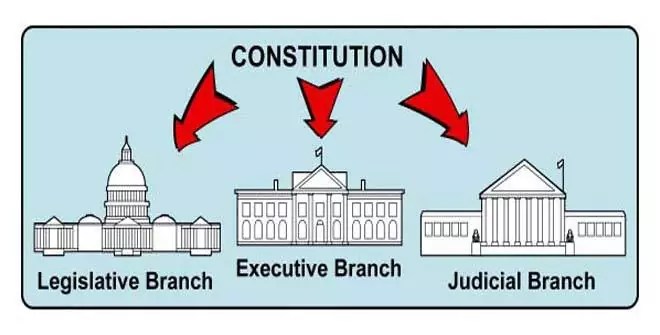
Separation of power is one of the most controversial issues worldwide. The doctrine has played a major role in the formation of constitution of numerous countries.The Essence of this doctrine states the presence of clear democratic lines in the function of the organs of a state. (the Legislature, Executive and judiciary)
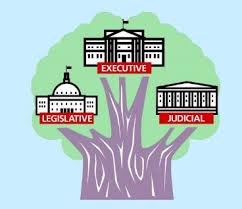
The theory of separation of power advocated the separate and independent functioning of the 3 organs of the government. The legislature should use only law-making power, the executive should only undertake law enforcement functions and the judiciary should only perform judicial functions such as interpretation of law and the constitution.
According to this theory Separation of power, the Responsibilities of these organs should be clearly defined and kept separate which is essential for securing the liberty of the people and for enabling the government to work systematically and efficiently.
This theory has been proposed by the French philosopher Montesquieu in his book Sprit of laws.

The basic philosophy behind this theory is that “there shall be no concentration of government power in a single authority.”For :
- To prevent autocratic rule in country.
- To safeguard the individual liberty.
In the context of nepal ,
The legislative branch is responsible for enacting the laws of the state and appropriating the money necessary to operate the government, the executive branch is responsible for implementing and administering the public policy enacted and funded by the legislative branch and the judicial branch is responsible for interpreting the constitution and law and applying their interpretations to controverse brought before it .
There are many provisions in the Constitution of nepal (2072) where both the functional and personal overlapping among three organs prevails. In Nepal, there is no strict separation of power but the functions of the different branches of the government have been Sufficiently differentiated and followed with check and balance.
Objective of Separation of Power
- To eliminate the corruption
- To prevent abuse of authority
- To ensure liberty for citizens by protecting from tyranny of government.
- To distributes the power of the state
- To maintain rule of law
- To limit government power
- Independence of the judiciary
*Check and Balance :
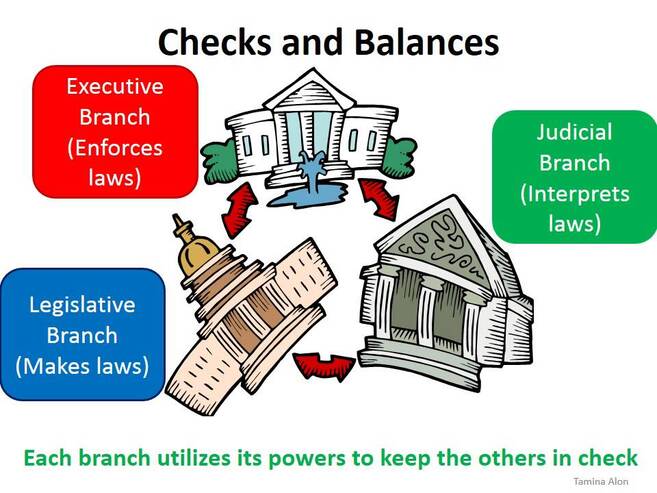
Absolute separation of power is neither nor suitable. therefore there is the necessity of check and balance.
Check and balance is supposed to be the principle of government which distinguished legislative, executive and judicial power and seeks to ensure that any misuse or excessive use of power by anyone can and will be checked and balanced by one or both of the other organs of government.
The right of one organ over the other organs of governing system to interfere in some special condition is called check and balance.
In the context of Nepal,
(1) Legislative control over executive
- Parliamentary Government system
- House of Representative has formation of executive
- Cabinet is formed from among the member of the federal parliament
- P.M and ministers are collectively responsible to the federal Parliament
(2) Legislative control over judiciary
- The appointment of chief justice of Supreme Court has been recommended by constitutional council. In such constitutional council majority of members from the House of Representatives.(federal parliament)
- The chief justice and justice of supreme court must undergo parliamentary hearing before their appointment. (Article 229)
- The Supreme Court submits their annual report to the president annually and such report is presented in federal parliament by prime minister.(Art:138)
- The specialized court ,judicial bodies, or tribunals can be established and formed in accordance federal law.
- The chief justice and supreme court judges and the members of judicial council can be impeached by parliament. (Art: 101)
- The law required for the judiciary to administer justice is also made by the legislature.
(3) Executive control over legislative
- The summoning and prorogation of eh session of the Legislature are done on the recommendation by the Executive (President (Art 93), Chief of State Art 183).
- Government Bill introduced only by the Executive (Art 110 (2))
- The resources and human resources required for the legislature are available by the Executive.
- Ordinance issuing (114)
- The motion of no-confidence cannot be brought until two years of the formation of the government.
(4) Executive control over judiciary
- Appointment of chief justice on the recommendation of the constitutional council. (chairperson -Prime minister )
- Judicial council , Judicial service commission having two representatives from the executive organs of the state.
- Resources and human resources necessary to the judiciary being made available by the executive.
- The executive’s right to pardon the sentences passed/decided by the judiciary, etc.are the provision of executive control over the judiciary.
(5) Judiciary control over legislative
- Judicial Review (133) (if a question arises as to whether legislative made law is with in the constitutional limits or not)
- Interpretation of the Constitution of law and the principles established by the SC are to be followed (128(4).
- There is a provisions that provides that all shall abide by the orders or decisions made in the course of the trial of lawsuits by the Courts (126 (2).
(6) Judiciary control over executive
- The power to test whether the actions of the executive are within the limits prescribed by the constitution or not.
- The judiciary has the right to declare rules, by-laws, directives e.t.c. issued by the executive organs null and void if they are inconsistence with the constitutionor the parent act.
- The executive is subject to judicial control through provisions like the obligation to follow court decisions /orders {Art:126(2)}and principles established by the Supreme Court {Art, 128 (4)}.
Reference;
- Constitution of Nepal,2072


You’ve managed to create something both thought-provoking and deeply comforting — not an easy feat.
Thank you so much for your kind words. Your feedback truly motivates me to keep writing.