
➤ The word property is used in numerous senses in general. If we look around the surroundings, everything available may be categorized as property. Every object whether tangible or intangible having some value to human beings may be termed as property.
The essential characteristics of property is the value attached to it. In one way or the other, it is a source of wealth. The value although may be either monetary or personal. In a general sense, therefore property consists of land, chattels, buildings and debts due to another persons.
However, the term Property when used in the legal sense has a definite connotation. It is the right to enjoy and to dispose of certain things in an absolute manner as one thinks it fit.
The word “Property” is derived from the Latin term ‘Proprietat’ and its French equivalent ‘Propreus’ which means a thing owned.
Property exhibits relation between a person and an object. The concept of property and ownership are very closely related to each other. There can be no property without ownership and no ownership without property. For the protection and recognition of it, there is the existence of Property law. Property law regulates how property is owned, used, transferred and protected, including rules about possession, ownership, transfer of title, lease, mortgages, and inheritance.
The term property is used in difference senses.Such as :
- All legal rights:
In the broadest sense, ‘Property’ includes all the proprietary as also personal rights possessed by a person. Blackstone considered even the rights that the master has over his servant or that a parents has over his child a proprietary right.
According to Hobbes, every individual has a right to preserve his property, that is his life, liberty and estate. And also Locke includes the personal rights of life, liberty and estate in proprietary rights.
This usage has become obsolete and find place only in the works of the old jurists like Blackstone, Hobbes and Locke. Today, however, it is not accurate to include personal rights in the category of rights of property.
- Proprietary rights (Dominum and Status)
In the narrower sense, the term property includes proprietary rights of person and not his personal rights. Thus, the land, buildings, fields, farm, machinery, furniture, ornaments and other personal effects and the things chosen in action, possessed by a person, constitute his property.
In this sense a man’s land, chattels shares and his debts due to him are his property; but not his life, liberty or reputation.
- Proprietary rights in rem. (Dominium oblige)
In its oldest and narrow sense, the term property means only such of the proprietary rights of a person as operate in rem; not in personam. It includes nothing more than Corporeal and incorporeal property. In this sense, we include only proprietary rights in rem, that is, rights as against the whole world as such.
It includes a free hold or lease hold estate in the land, or a patent or Copyright; but not a debt or the benefit of a contract.
Salmond takes the term property in this sense. “The law of property is the law of proprietary rights in rem, the law of proprietary rights in personam being distinguished from it as the law of obligation.”
Definition of property
According to Salmond “All legal rights, proprietary rights, Corporeal property, proprietary rights in rem is called ‘Property’.”
According to Austin “Property is taken in its strict sense denotes a right, indefinite in point of use, unrestricted in point of disposition and unlimited in point of duration over a determinate things.”
According to Black’s Law Dictionary “The exclusive rights of possession enjoying and disposing of a thing cosider as property.”
As per the Constitution of Nepal 2072, Explanation given by Article 25 “Property means all types of movable and immovable property and the words also include intellectual property.”
According to National Civil Code, 2074, Section 251 “Any cash, goods or work shall be deemed to be a property if such cash, goods or action can be used or transacted in or the title thereto can be transferred by way of purchase, sale or otherwise or any benefit can be derived from it.”
The Universal Declaration of Human Rights, 1948 has also mention about the right to property as per (Article 17) “Everyone has a right to own property alone as well as in association with others.”
The case of R.C. Cooper Vs UOI (1970) In this case, the Supreme Court of India states that property means a “Highest rights that a man can have to any things”.
Kinds of Property
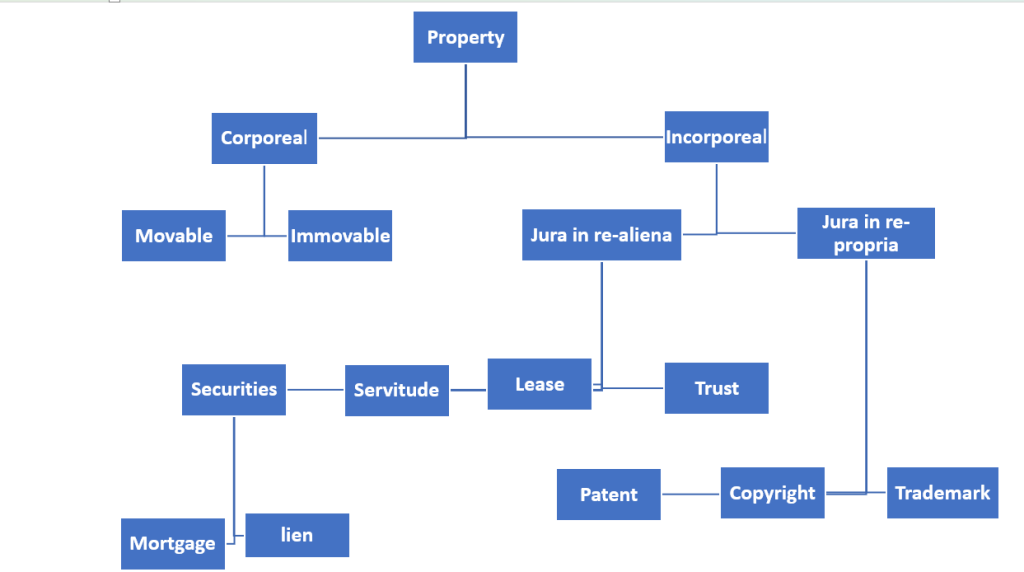
According to Salmond , Property Can be mainly Classified into two types i.e.
(i) Corporeal Property
(ii) Incorporeal Property
(A) Corporeal Property:
Corporeal property means material things or objects which is physically and tangibly existed in a material world.
Corporeal Property is the right of ownership in material things. Corporeal property can also be called as tangible or material property. It relates to material objects for example, movable things, land and all things permanently attached to it.
It maybe both movable and immovable. E.g: House, Land, Car, Bike e.t.c.
Corporeal Property can be divided into two types
(i) Movable Property: Movable property is all types of property that can be physically transferred from one place to another without altering their nature and substance. It is not permanently attached to the land. For examples: Vehicles, books, Jewelry, e.t.c
(ii) Immovable Property: Immovable property is the land, buildings and the things permanently attached to the land or structures, which cannot be moved without altering their nature or damaging the property.
(B) Incorporeal property:
Incorporeal property are also called as intellectual or Conventional property. It includes all those valuable interests which are protected by Law. Incorporeal property is intangible. It cannot be perceived by senses. For example: Patents, Copy rights, Trademarks e.t.c.
It can be divided into two classes i.e.
(i) Right in Re-aliena(Jura in re-aliena ): Right in re aliena means a legal right or interest that a person has in someone else’s property. It is also known as jus in re aliena. Some important rights of this class are:
(a)Securities: Securities are legal rights over property given to a creditor to ensure repayment of a debt or performance of an obligation. The purpose behind the securities is to give the creditor confidence that if the borrower fails to pay, the creditor can recover the debt by selling or using the property. There can be two types of securities:
- Mortgage: A Mortgage is the transfer of an interest in immovable property by a mortgagor(borrower) to a mortgagee (Lender) as security for a loan.For Example: If a borrows Rs 10 lakhs from a bank and mortgages his house. If he fails to repay, the bank can sell the house to recover the loan. It may be mortgage with p[ossession, Mortgage without possession and re-mortgage.
- Lien: A Lien is the right to hold the property of another person as a security for the performance of obligation. In other word, a lien is the legal right to keep someone else’s property in possession until they pay the money due for that property or related service. Generally lien applies to only movable property. For example: A goldsmith repairs a necklace for Ms’B’ until she pays the repair charges, the goldsmith can keep or possess the necklace.
(b)Servitude: Servitude is the right to use others property under law. A servitude is a right enjoyed by one person over another person’s land for a specific purpose or benefit. The owner of the land must allow this right, even if it limits their own use of the land.
If there is a provision entitling the owner of an immovable property to enjoy or use any immovable property or any part thereof in which another person has title, ownership or possession, a Servitude shall be deemed to have been created.
Servitude would not apply be applied in case of movable properties. It would be applied in the Context of Contract, nature of place of immovable properties, usages and customs remained from ancient time.
for example: Right of way across a neighbour’s land.
(c) Lease: A lease is a legal arrangement in which the owner of immovable property gives another person the right to use and enjoy that property for a specific period in exchange for payment.
The person who gives property or goods under his/her title and ownership is called lessor and person who takes others property in lease is lessee.
Under lease, the ownership remains with the lessor, the lessee only gets possession and enjoyment on the property, which means in Lease only possession rather than ownership shall be transformed.
(d) Trust: A Trust is a legal arrangement where one person (trustee) hold property for the benefit of another person (beneficiary) according to the terms set by the person who created the trust.
The trustee is the legal owner of the property, but must use it for the benefit of the beneficiary. Ownership of trust properties shall remain under the title of trustee and beneficiaries are regarded as their de facto owner.
(ii) Right in re-propria (Jura in re propria )
Jura in re propria means rights over property which a person owns himself. The owner has full legal rights to use, enjoy and dispose of the property without needing permission from anyone.
In Incorporeal property, this usually refers to intellectual property rights and similar exclusive rights. Right in re propria are ‘those rights of ownership in one’s own property as are not exercised over material objects.’
Ownership of some non-material things produced by human skills and labour is recognised as property. The most important of such rights are Patents, Literary Copyright, trademark etc.
The recognition and protection of this kind of incorporeal property has been of recent origin. The immaterial product of a man’s brain may be as valuable as his land or his goods.
The law, therefore, gives him a proprietary rights in it, and the unauthorized use of it by other person is violation of his ownership, no less than theft and trespass.
The Intellectual properties or immaterial forms of property are as follows:
- Patent:
A Patent is a form of Intellectual Property that grants the inventor exclusive rights to their invention for a specific period. A patentee is a person to whom a patent has been granted. Patent is a privilege granted to the first inventor of an invention. It is an exclusive legal rights which granted to an inventor to make, use and sell an invention for a certain period.
Example: Patent for a new type of water purifier, which grants only the inventor can produce or license it.
As per section 2 ‘g’ of The Patent, Design and Trademark Act, 2022 (1966) “Patent” means any useful invention relating to a new method of process or manufacture, operation or transmission of any material or a combination of materials or that made on the basis of new theory or formula.
2.Copyright:
Copyright is the exclusive legal right granted to the creator of original literary, musical, artistic or other intellectual works to reproduce, publish, perform, adapt or distribute the work usually for a limited period, while protecting it from unauthorized use.
In Nepal, the protection of intellectual property which falls under Copyright or creator’s original works is protected by Copyright Act, 2059.
3.Trademark:
Trademark is a sign capable of distinguishing the goods or services of one enterprise from those of other enterprises. Trademarks are protected by intellectual property rights.
As per the The Patent, Design and Trade Mark Act, 2022 Section 2’c‘ “Trade-mark” means word, symbol, or picture or a combination
thereof to be used by any firm, company or individual in its products or services to distinguish them with the product or
services of others.
Trademarks date back to ancient times when artisans used to put their signature or ‘mark’ on their products. Trademarks helps to protect brand identity and may prevent others from using similar marks that may cause confusion. For example: Coca-Cola Logo, Apple Symbol e.t.c.
It also helps to build customer trust, promotes fair competition and adds commercial value to a business. These protection are granted through National Legislation. et.c.


